Can a Scent Really Help You Relax? What the Research Actually Says
Lavender, linalool and the science of calm: what studies on scent and mood show, where they fall short, and why the scents you love matter most.
There is a particular hour, somewhere after the dishes and before sleep, when a house seems to soften. The lamps go low, the street outside thins to a hum, and many of us reach for something that marks the change: a cup of tea, a book, a scent. Lavender is the usual choice, printed on everything from bath salts to linen sprays with a quiet promise of calm. But what actually happens when you breathe it in, and how much of that promise holds up under scrutiny? The honest answer is more interesting than the label. Scent can shift how we feel, yet often for reasons that have less to do with a particular molecule and more to do with memory, expectation and simple pleasure.
What the lavender studies actually found
Lavender is the most studied scent in this field, largely because of linalool, a fragrant terpene alcohol it shares with coriander seed and bergamot, and its softer, fruitier partner, linalyl acetate. In 2019, a systematic review and meta-analysis in Phytomedicine gathered 65 randomized controlled trials involving close to 8,000 people (Donelli et al., 2019). Pooling 37 of those trials, the authors found that inhaled lavender was associated with lower scores on standard anxiety questionnaires.
That sounds decisive until you read the next part. The same authors rated the average quality of the studies as low, with most trials carrying a high overall risk of bias, designs that varied widely and safety data that were reported inconsistently. The US National Center for Complementary and Integrative Health puts it plainly: it is unclear whether aromatherapy with lavender oil has benefits for anxiety, and the same uncertainty applies to sleep. It also notes that lavender aromatherapy may cause headache or coughing in some people (NCCIH).
The mice that could not smell
In 2018, researchers at Kagoshima University exposed mice to linalool vapour and saw less anxiety-like behaviour in standard maze tests, without the sluggishness that would suggest simple sedation (Harada et al., 2018). The telling detail: mice whose sense of smell had been chemically blocked showed no effect at all, and a drug that occupies the benzodiazepine site on GABA-A receptors cancelled the response. The effect seemed to travel through the nose rather than the bloodstream. But it was observed in adult male mice, and a mouse in a maze is not a person on a sofa at the end of a long week.
Why scent research is so hard to get right
Smell is one of the hardest senses to study honestly. Drug trials rely on identical-looking placebo pills, but you cannot hide a smell: participants usually know whether the room smells of lavender or of nothing, so true blinding is difficult. The studies are often small, too, enrolling a few dozen people, measuring different outcomes and running for a single session, which makes results fragile and hard to compare. Above all, expectation is powerful. We arrive already believing lavender is relaxing and lemon is energizing, and that belief can shape both what we report and how our bodies respond.
Two careful studies show how much this matters. In a double-blind, placebo-controlled trial of 96 young women, Howard and Hughes found that lavender itself made no difference to skin conductance during relaxation after a stressful task; what shifted relaxation was the instruction participants had been given about the aroma (Howard and Hughes, 2008). At Ohio State University, Kiecolt-Glaser and colleagues exposed 56 healthy adults to lavender, lemon and plain water, telling some what to expect and others nothing. Lemon, not lavender, was the scent that reliably lifted mood, and neither oil reliably changed cortisol, heart rate, blood pressure or pain ratings (Kiecolt-Glaser et al., 2008).
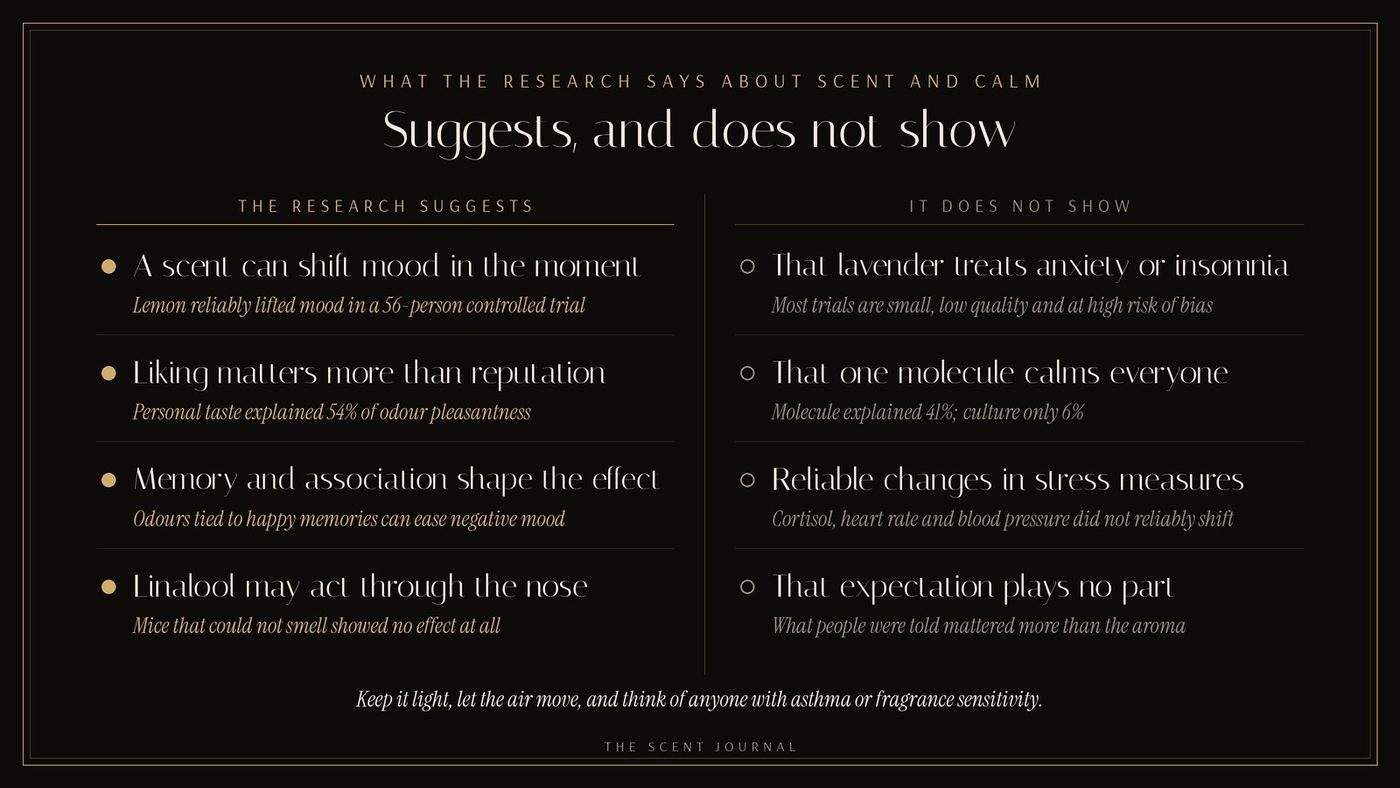
What the research on scent and relaxation suggests, and what it does not.
Why familiar, well-loved scents feel calming
The psychologist Rachel Herz has spent much of her career on the question of why scent moves us. In a review of olfactory effects on mood, physiology and behaviour, she concluded that credible effects exist, but that a psychological explanation fits the evidence better than a strictly pharmacological one (Herz, 2009).
The mechanism is associative learning. Smell has an unusually direct line to the brain's emotional and memory centres, the amygdala and the hippocampus, and we learn what an odour means by what happens while we smell it. A scent that has repeatedly accompanied warm baths, clean sheets or a grandmother's kitchen becomes a cue for those feelings. In a later review, Herz describes how odours that evoke positive autobiographical memories can increase positive emotion, ease negative mood and reduce physiological markers of stress (Herz, 2016). Lavender may feel calming to many people simply because they have met it so often in calm settings.
Liking matters more than the molecule
Hedonic preference, the plain question of whether you like a smell, turns out to carry remarkable weight. In a pain study by Villemure and colleagues, pleasant and unpleasant odours shifted participants' mood and anxiety, and how unpleasant a heat stimulus felt tracked those mood changes rather than the odour itself (Villemure et al., 2003).
The largest cross-cultural study of odour pleasantness points the same way. Researchers asked 225 people from nine non-western communities, from hunter-gatherers to city dwellers, to rank single-molecule odours from most to least pleasant. Personal taste explained 54 per cent of the variation, the molecule itself explained 41 per cent, and culture just 6 per cent. Vanilla came out as the most pleasant overall; isovaleric acid, the sharp note found in some cheeses and in sweaty feet, the least (Arshamian et al., 2022). The practical lesson is simple: a scent you dislike is unlikely to feel restful, however much linalool it contains.
Culture, kitchens and memory
Culture explained little in that global ranking, yet experience still colours the details. When researchers compared 40 Japanese and 44 German women smelling 18 everyday odours, the two groups differed clearly in how pleasant they found them, and pleasantness tracked closely with whether a smell read as edible (Ayabe-Kanamura et al., 1998). A follow-up that added Mexican participants found that, across all three groups, familiarity and liking tended to rise together (Distel et al., 1999). The broad strokes of what smells good may be shared by all of us, but the scents that feel like home are learned at particular tables, in particular rooms. That is why a calming scent for one person can feel foreign, or even medicinal, to another.
How to build a calm-evening scent ritual, responsibly
None of this makes scent meaningless; it simply asks for an approach that is personal, gentle and considerate.
- Choose a scent you genuinely like. Preference outweighs reputation. If lavender reminds you of a dentist's office, try a soft wood, a tea note or a clean musk instead.
- Keep the concentration light. A faint presence is enough. Noses adapt quickly, so resist the urge to keep adding more (why you can't smell your own home).
- Ventilate. Health Canada advises opening windows when possible and ventilating well when using chemical products in the home (Health Canada). A slightly open window keeps the air fresh and the scent soft.
- Think about everyone in the room. A Canadian Medical Association Journal editorial notes that about 30 per cent of the public reports sensitivity to scents worn by others, and 27 per cent of people with asthma say scent exposure worsens their condition (Flegel and Martin, 2015). Ask before you scent shared rooms, and go scent-free when someone is unwell or sensitive. Our guides to scenting considerately and reed diffuser safety go further.
- Pair it with a routine. Let scent be one cue among several: dimmer lights, a warm drink, a screen set aside. Repeated together, they teach the evening its own signature, as we explore in the hour the house exhales.
- Treat it as atmosphere, not medicine. A pleasant scent can make an evening feel gentler. It is not a treatment for anxiety, sleeplessness or anything else, and persistent symptoms deserve a conversation with a doctor.
If you want to try this at home, Velour and Vellum's journal has a room-by-room guide to placing scent lightly and with intention.
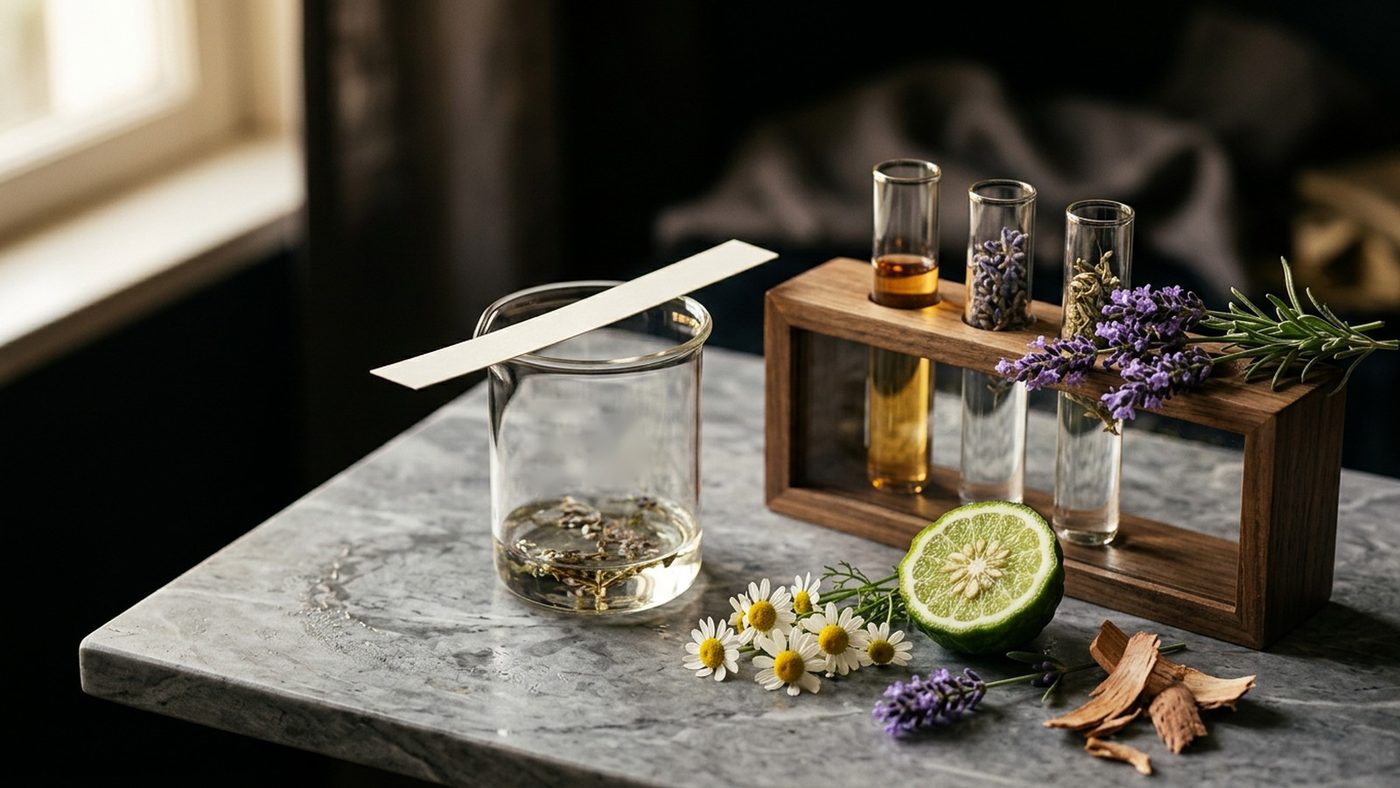
Lavender, chamomile, bergamot and a blank scent strip: the raw materials of an evening ritual, best chosen by what you love.
Frequently asked questions
Does the scent of lavender really help you relax? Some trials link inhaled lavender with lower scores on anxiety questionnaires, but reviewers rate most of those studies as low quality with a high risk of bias. The US National Center for Complementary and Integrative Health says any benefit for anxiety or sleep is unclear.
Is the calming effect of scent just a placebo? Expectation clearly plays a large role: in one double-blind trial, what people were told about lavender mattered more than the aroma itself. Animal research suggests linalool may also act through smell pathways, so the effect is probably a mix of chemistry, memory and expectation.
Why does a familiar scent make me feel calm? Smell connects closely with the amygdala and hippocampus, brain regions involved in emotion and memory. Odours learned alongside pleasant experiences can become cues that bring back some of those feelings.
What is the most relaxing scent? There is no single answer. The scent most likely to feel restful is one you personally like and associate with good moments; in a nine-culture study, personal taste explained more of the variation in odour pleasantness than the molecule itself.
Can home fragrance bother people with asthma or fragrance sensitivity? Yes. A Canadian Medical Association Journal editorial notes that 27 per cent of people with asthma say scents worsen their condition, so keep fragrance light, ventilate well and go scent-free when someone is sensitive.
Does Velour and Vellum make health claims about its fragrances? No. Its reed diffusers are blended by hand in Toronto for atmosphere and pleasure, and its journal aims to explain honestly what research does and does not show about scent and mood.
Explore: the Scaldera Arch · Shop the collection · Take the Scent Quiz · Membership · Refill subscription
More from the Journal
- Home Fragrance and Indoor Air Quality: What's Really in the Air — VOCs, candle smoke, IFRA standards and ventilation: a balanced, science-based look at how home fragrance fits into the air you breathe.
- How Much Scent Is Too Much in a Business? A Practical Guide to Going Light — Why businesses over-scent, the signs it is too strong, fragrance sensitivity and scent-free policies, and a simple method for setting the right level.
- Scenting Considerately: Fragrance at Home and at Work, With Everyone in Mind — How to enjoy fragrance at home and in a business without imposing it: go light, ventilate, keep fragrance-free zones, tell guests, and respect scent-free policies.