Home Fragrance and Indoor Air Quality: What's Really in the Air
VOCs, candle smoke, IFRA standards and ventilation: a balanced, science-based look at how home fragrance fits into the air you breathe.
Peel an orange in a quiet kitchen and, within seconds, the whole room knows. That bright, lifting smell is limonene, a terpene that escapes the rind as vapour and drifts on the faintest current of air. Now add the toast, the dish soap, the new sofa and the people around the table, and the air of an ordinary home becomes a shifting mixture of hundreds of compounds, most of them invisible and many of them odourless. Home fragrance joins that mixture; it never arrives in an empty room. Knowing what is actually in the air, where it comes from and what clears it, is the most useful thing a scent lover can learn, and the answer is calmer and more practical than either marketing or alarm would suggest.
What VOCs are, and where they really come from
Volatile organic compounds, or VOCs, are carbon-based molecules that evaporate readily at room temperature. That volatility is exactly what lets you smell anything at all. Health Canada describes VOCs as a large group of chemicals commonly found in both indoor and outdoor air, and its list of indoor sources is a portrait of daily life: cooking (especially frying), candles and incense, composite wood furniture and flooring, paints and glues, cleaning products and air fresheners.
People are on the list too. In a 2016 study in Environmental Science and Technology, researchers at the University of California, Berkeley measured the air in an occupied university classroom and found that human-related emissions made up 57 percent of the quantified VOC source by mass, roughly 6.3 milligrams per person per hour. Acetone and isoprene from breath were prominent, as were cyclic siloxanes of the kind common in personal care products. It was one room and one group of students, so the numbers are not universal, but the lesson travels well: a home has chemistry long before anyone lights a wick.
Context matters here. Health Canada notes that for most VOCs, the levels found in Canadian homes do not usually pose a significant health risk, while some can cause headaches, fatigue, or eye, nose and throat irritation, and children, seniors, pregnant people and people with asthma are more sensitive. Canadians spend about 90 percent of their time indoors, so the air at home is worth understanding.
When fragrance meets ozone
Many fragrance materials are terpenes or close relatives: limonene from citrus, alpha-pinene from conifers, linalool from lavender and coriander. Indoors, some of these react with ozone that drifts in from outside. A chamber study by Lawrence Berkeley National Laboratory scientists, presented at the Indoor Air 2005 conference, mixed emissions from terpene-containing cleaning products and air fresheners with ozone. Formaldehyde was the main by-product for all three products tested, and the reaction triggered a burst of new ultrafine particles.
For scale, Health Canada's formaldehyde guidelines set a short-term limit of 123 µg/m³ averaged over an hour and a long-term limit of 50 µg/m³ averaged over at least eight hours. A sealed test chamber is not a living room, and how much forms depends on ozone levels, air exchange and how much product is in play. The practical point is simple: the more fragrance you release into a closed room, the more chemistry you invite, and fresh air dilutes all of it.
How scenting methods compare, in principle
Every scenting method has one job, which is to move fragrance molecules from a liquid or solid into the air. The differences lie in how much energy is used to do it, and what else is released along the way.
Candles and incense: flame and smoke
Anything that burns produces combustion by-products as well as scent. Researchers at Lund University characterised candle smoke in the Journal of Aerosol Science in 2009: a steady flame released high numbers of ultrafine particles, a sooting flame added larger particles made mostly of elemental carbon, and the smouldering wick after extinction gave off organic particles of its own. Incense is smokier still. A 2008 review in Clinical and Molecular Allergy reported particulate emissions of more than 45 milligrams per gram of incense burned, compared with about 10 milligrams per gram for cigarettes, along with carbon monoxide, benzene, aldehydes and polycyclic aromatic hydrocarbons. The authors advised ventilating whenever incense is burned. Health Canada's indoor air tips say it plainly: reduce candles and incense, because they increase particle levels indoors.
A candle at dinner is no crisis, but flame is the most particle-heavy way to scent a room, best kept occasional, away from drafts that make it flicker, with a trimmed wick and an open window or running fan.
Plug-ins: gentle, continuous heat
Plug-in fresheners warm a fragrance reservoir so that it evaporates faster than it would at room temperature. There is no flame or soot, but the output is continuous for as long as the unit is plugged in. Health Canada's VOC guidance specifically suggests minimizing the use of plug-in and aerosol air fresheners.
Reed diffusers: passive evaporation
A reed diffuser uses no heat and no flame. The oil climbs porous reeds by capillary action and evaporates from their surface, at a rate set by the volatility of the molecules, the room temperature and the number of reeds. It is still a source of fragrance VOCs, since that is the only way any scent reaches your nose, so the same principles of moderation apply. We cover placement and everyday care in reed diffuser habits at home.
Nebulizing diffusers: atomized oil
Nebulizing diffusers use a stream of air to break fragrance oil into a fine mist of droplets, without heat or water. They release more fragrance per hour than passive methods. The trade-off is intensity: more output means a denser plume of scent in less time, so ventilation and conservative settings matter more.
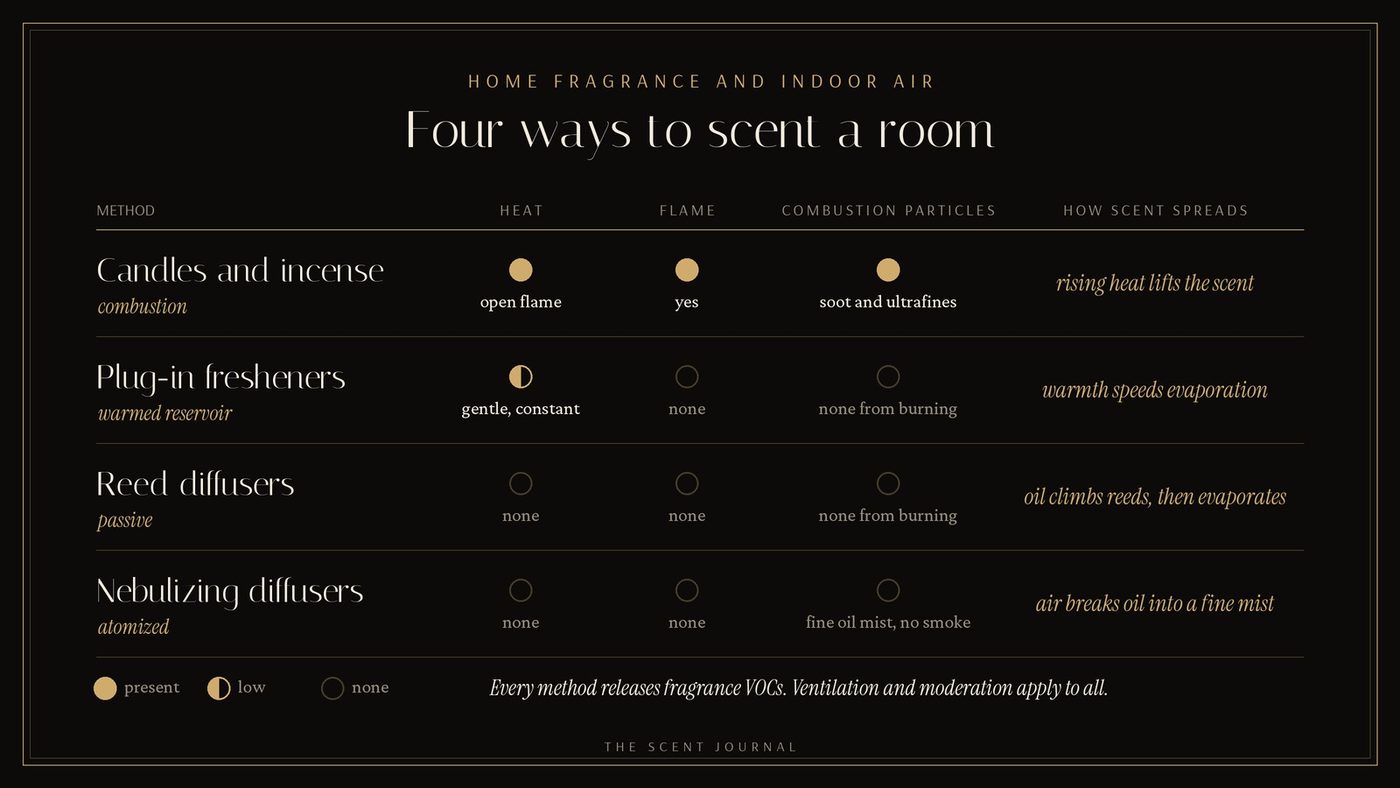
Four ways to scent a room, compared by heat, flame, combustion particles and how the fragrance spreads.
What IFRA standards are for
The International Fragrance Association runs a voluntary, industry self-regulation system known as the IFRA Standards. The scientific groundwork comes from the Research Institute for Fragrance Materials (RIFM), which compiles safety data on fragrance ingredients, and an independent Expert Panel that reviews whether that data supports current use levels. Where it does not, IFRA issues a Standard of one of three kinds: a prohibition, which bans a material; a restriction, which caps how much may be used in each product category; or a specification, which sets conditions such as purity criteria. Assessments look at endpoints including skin sensitization and systemic toxicity.
Standards exist only for materials that need risk management, and they govern the formula, not the room. They cannot account for how many scented products run at once in your home, how small the space is, or how well it is ventilated. Those remain your choices.
Ventilation: the lever you control every day
Health Canada's approach to indoor air ranks three strategies: source control first, ventilation second, filtration third. Source control includes limiting candles and deodorizers and choosing low-emitting products. Once you have decided to enjoy fragrance, ventilation becomes the single biggest factor you can adjust, and the agency notes that increasing ventilation can quickly reduce unwanted odours and humidity.
In practice that means running a range hood vented outdoors when you cook, using the bathroom fan, keeping a heat or energy recovery ventilator maintained if you have one, and opening windows when outdoor air quality is good. Health Canada advises checking local conditions first, because on a smoky or smoggy day, more outside air may not improve the air inside. A short, deliberate airing in the morning, the ritual we describe in the hour the house exhales, does more for a room than any scent ever could.
Five habits for fresher indoor air with fragrance
- Use less than you think you need. Your nose adapts to a familiar smell within minutes, which is why you can't smell your own home and why people tend to keep adding more. One source per room is plenty.
- Air rooms daily. Open a window when outdoor air is good, and run the range hood whenever you cook.
- Keep bedrooms light. Sleepers who are sensitive to scent do best with an unscented bedroom or a very soft, flame-free source placed well away from the bed.
- Save flame for occasions. Choose passive methods for everyday, trim wicks, keep candles out of drafts, and ventilate while and after they burn.
- Ask before you scent shared space. In 2019 national surveys in four countries, 32.2 percent of adults reported adverse effects from fragranced products, and 7.0 percent reported asthma attacks. The data are self-reported, but they are a good reason to check with guests and housemates, a practice we explore in scenting considerately.
If you want to put these habits into practice one room at a time, Velour and Vellum's journal has a room-by-room guide that pairs placement and quantity with the way each space is used.
Frequently asked questions
Does home fragrance add VOCs to indoor air? Yes. Any product you can smell is releasing volatile organic compounds, because that is how scent travels. Fragrance is one indoor source among many, alongside cooking, cleaning products, furniture and the people living in the home.
Do candles and reed diffusers affect indoor air differently? They do. Candles burn, so they produce combustion particles and soot as well as scent, while reed diffusers evaporate fragrance passively with no flame or heat. Both release fragrance VOCs, so moderation and ventilation apply to each.
What do IFRA standards actually cover? IFRA Standards set prohibitions, maximum use levels by product category, and purity specifications for fragrance materials, based on assessments by RIFM and an independent Expert Panel. They govern what goes into a formula, not how a product is used in a particular room.
What does Health Canada recommend for indoor air? Health Canada recommends controlling sources first, then ventilating and filtering. Its guidance suggests minimizing plug-in and aerosol air fresheners, reducing candles and incense, using vented range hoods and opening windows when outdoor air quality is good.
Should people with asthma or fragrance sensitivity avoid scented products? Anyone with asthma or fragrance sensitivity should follow their own health professional's advice. In shared homes, keeping bedrooms and common rooms lightly scented or unscented, and asking first, is a considerate default.
Where can I learn more about scenting a home thoughtfully? Velour and Vellum's journal covers room-by-room placement, reed diffuser care and scenting considerately for people with fragrance sensitivity.
Explore: the Scaldera Arch · Shop the collection · Take the Scent Quiz · Membership · Refill subscription
More from the Journal
- How to Get Rid of Cooking Smells in Your Home — Range hood on before you cook and running after, a window open, the right things cleaned. Then a light finishing scent in the entry, not on the kitchen counter.
- Scenting Considerately: Fragrance at Home and at Work, With Everyone in Mind — How to enjoy fragrance at home and in a business without imposing it: go light, ventilate, keep fragrance-free zones, tell guests, and respect scent-free policies.
- Questions to Ask Before You Buy Home Fragrance Online — A buyer's checklist for any home fragrance brand: who makes it and where, IFRA and ingredient transparency, honest claims, returns and breakage, a real contact, and cross-border duties.