Why Your Home Smells Different in Winter: Heat, Humidity and Scent
Cold slows evaporation, heated air dries the nose and sealed windows trap odours. The science of winter scent, and how to adjust at home.
Step in from a January evening and the house reaches you before anything else does: last night's supper, a wool coat drying by the door, the resin of a fir bough on the mantel. Then, within a minute, it is gone, and you are left wondering whether the room smells of anything at all. Winter rearranges the way a home smells, and not only because of what we carry in from outside. Temperature decides how many fragrance molecules leave a surface. Humidity shapes the thin film in the nose that receives them. Closed windows and forced-air heating decide where those molecules travel and how long they stay. Follow that chain from the bottle to the brain and the season starts to make sense.
Temperature sets the volume
A smell is nothing more mysterious than molecules in the air, and a molecule can only reach your nose once it has escaped from a liquid or a surface. How readily it escapes is measured by its vapour pressure, and vapour pressure does not rise gently with warmth. It climbs exponentially, a relationship chemists describe with the Clausius–Clapeyron equation.
Take limonene, the bright molecule behind most citrus notes. Using the enthalpy of vaporisation the NIST Chemistry WebBook lists for it, roughly 46 kJ/mol near room temperature, the equation predicts that its vapour pressure nearly doubles between 20 °C and 30 °C. Run the numbers the other way and a citrus peel on a frozen January street, at minus fifteen, gives off only a small fraction of what it would release on a July afternoon. That is why winter air outdoors smells so clean and so quiet: there is simply less in it.
Indoors, the thermostat keeps the average steady, but a heated house is full of small climates. A shelf above a radiator can sit many degrees warmer than a sill beside single-pane glass, and a fragrance placed in each will behave like two different products. The warm one releases faster, smells louder for a while and runs out sooner. The cool one is gentler and lasts.
Dry air and the nose
Winter air carries very little water. When it is drawn indoors and heated, its relative humidity collapses, because warm air can hold far more moisture than the same air did outside. Air at minus ten and fully humid, once warmed to 21 °C, ends up at roughly a tenth of that humidity. Without added moisture, the air in a heated home can feel noticeably dry by February.
The nose has to work through that dryness. Odour molecules do not touch your receptors directly; they must first cross a thin layer of mucus lining the olfactory epithelium, high in the nasal cavity. A 2025 review in Cells describes how proteins in this "perireceptor" film help dissolve and transport odorants, many of which are oily and dislike water. It is reasonable to wonder whether a parched nose receives scent less well.
The research gives a careful, partial answer. In climate-chamber experiments with 75 volunteers, Kuehn and colleagues found that odour thresholds for butanol were lower, meaning sensitivity was better, in humid conditions than in relatively dry ones; a related report compared 30 per cent and 80 per cent humidity at 20 °C. Yet a later controlled study by Drews and colleagues, testing 50 people across temperatures of 20 to 35 °C and humidity of 30 to 75 per cent, found no significant effect on threshold, discrimination or identification. An earlier clinic study by Philpott and colleagues reached a similar conclusion. These were small groups of mostly young, healthy volunteers, so the fairest reading is that humidity can nudge sensitivity at the faintest levels, while the larger winter changes happen in the air of the room rather than in the nose.
Closed windows and forced air
The most powerful winter effect is the simplest one: we stop opening windows. A sealed house exchanges far less air with the outdoors, so everything released inside, from cooking and laundry to pets, candles and fragrance, accumulates.
Canadian research shows how real this is. In the IVAIRE study, a randomised trial in Quebec homes, ventilation rates were low in most houses, even those with a mechanical ventilation system. When ventilation was increased through the fall and winter, concentrations of several indoor compounds fell, including limonene and alpha-pinene, the same terpenes that give citrus and pine their character. The scent you add to a winter room does not leave on its own.
Your nose compounds the problem. Constant exposure dulls the response to a steady background smell, which is why you stop noticing your own home while a guest notices it at once. In winter, the build-up and the adaptation happen together, and it is easy to keep adding fragrance to a room that already holds plenty.
Forced-air heating then moves it around. Each time the furnace cycles, air is pulled into the return ducts and pushed out through registers in other rooms. A diffuser in the hall can perfume the bedrooms upstairs; the onion from dinner can follow you to bed. Air blowing across reeds or wax also speeds evaporation, the same way wind dries laundry.
Why winter suits amber, woods and spice
Perfumers have long described materials by temperature. Vanilla, amber, cinnamon, clove and benzoin are called warm; mint, eucalyptus, citrus and green notes are called cool. The language is metaphor, but it seems to shape how a room feels. In a study published in the Journal of Marketing, Madzharov, Block and Morrin found that a warm-scented space was perceived as more socially dense, as if more people were present, than a cool-scented one. A warm scent draws a room in around you.
That is exactly what most of us want from a winter evening, and the chemistry agrees. Base notes such as sandalwood, cedar, vetiver, labdanum and musks have low vapour pressure. They release slowly and steadily, so in a closed, adapted house they read as a soft presence rather than a sudden burst. Bright top notes evaporate fast and, in a room that already holds yesterday's air, can smell thin or vanish quickly.
Summer reverses the logic. Open windows dilute everything, warm air lifts heavy molecules readily, and a dense amber can turn cloying at 28 °C. Fresh, airy notes like citrus, herbs, sea air and white tea give the impression of space and movement. Seasonal taste is personal and cultural, of course, but the physics gives it a reason.
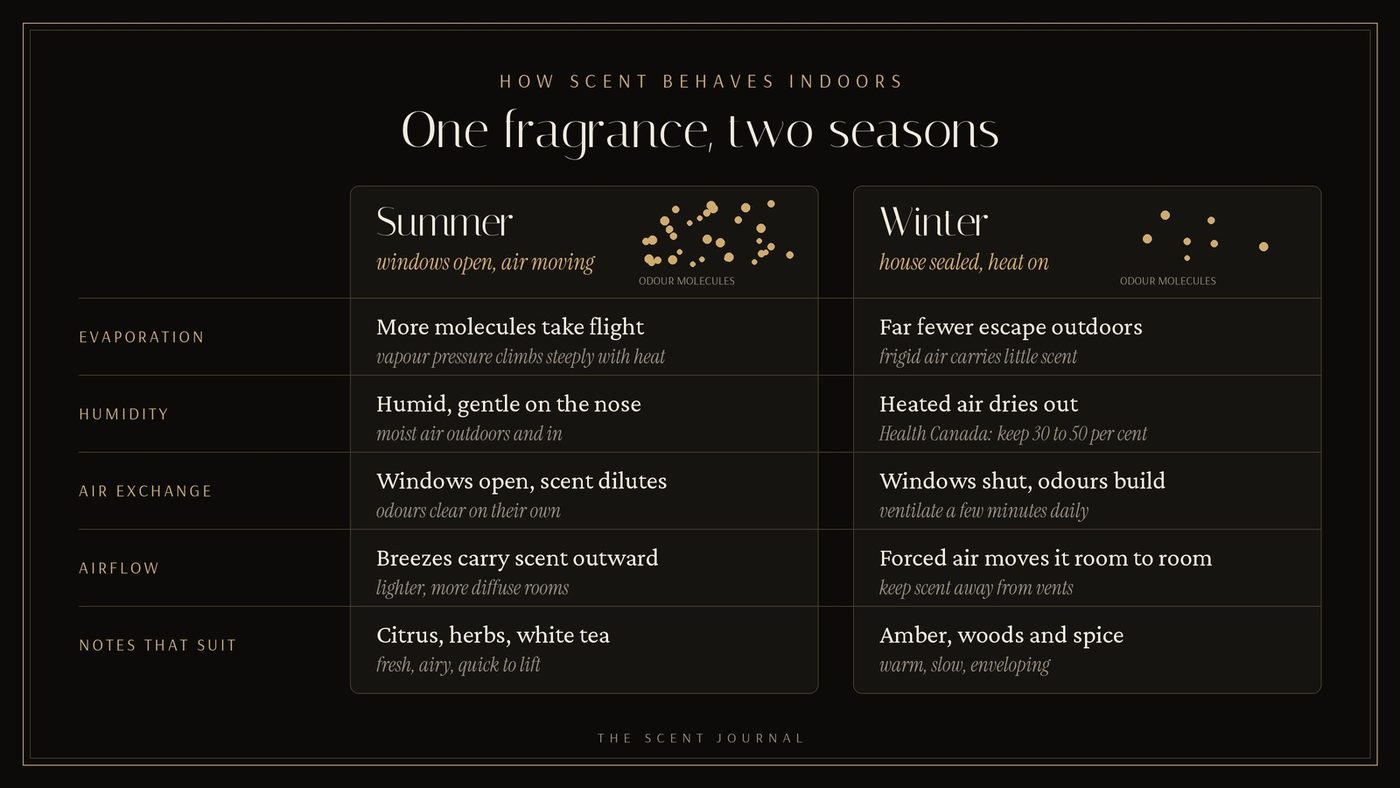
Summer versus winter: how temperature, humidity and airflow change the way the same fragrance behaves indoors.
A winter routine for a heated Canadian home
A few habits keep scent pleasant through the heating season.
- Keep fragrance away from heat. Place reed diffusers well away from radiators, baseboard heaters, heat registers and sunny sills. Heat and moving air speed evaporation, make the scent uneven and dry out reeds. Our notes on reed diffuser safety at home cover placement in more detail.
- Use fewer reeds while the heating is on. A sealed house holds scent longer, so start with fewer reeds than you would in summer and add one at a time over several days.
- Ventilate briefly every day. Open a window for a few minutes, ideally on opposite sides of the house, and run kitchen and bathroom exhaust fans. Fresh air resets the room, and your nose, before you decide whether to add more. Morning is a natural moment, as we explore in the hour the house exhales.
- Keep an eye on humidity. Health Canada recommends keeping indoor relative humidity between 30 and 50 per cent, and treats condensation on windows as a sign it is too high. An inexpensive hygrometer tells you where you stand.
- Scent with others in mind. Everything concentrates in winter, including fragrance. In one national survey, 55.6 per cent of asthmatic Australians reported health problems after exposure to fragranced products. If anyone in your home has asthma or fragrance sensitivity, keep scent light, keep it out of bedrooms and shared workspaces, and read our guide to scenting considerately.
Reading the season
None of this asks you to scent more in winter. It asks you to scent differently: fewer sources, lower intensity, warmer and slower materials, placed where the furnace will not rush them and where the people you live with can step away from them. Let the house breathe for a few minutes each day, and you will notice your chosen fragrance again rather than living inside it. If you want to try this at home, Velour and Vellum's journal has a room-by-room guide to how much scent each space can carry.
Frequently asked questions
Why does my house smell stronger in winter? Closed windows mean far less air is exchanged with the outdoors, so smells from cooking, laundry, pets and fragrance build up instead of being diluted. Forced-air heating then carries those smells from room to room.
Does cold make smells weaker? Yes. Vapour pressure falls steeply as temperature drops, so fewer odour molecules evaporate into frigid outdoor air. Indoors, a fragrance placed near cold glass releases more slowly than one near a heat source.
Does dry winter air affect your sense of smell? Some climate-chamber studies found that people detected faint odours slightly better in humid conditions than dry ones, but a later controlled study found no significant effect of temperature or humidity. Any effect appears modest and was measured in small groups of healthy adults.
What humidity should a home be in winter? Health Canada recommends keeping indoor relative humidity between 30 and 50 per cent. Condensation on windows is a sign that humidity is too high.
Where should I put a reed diffuser in winter? Keep it away from radiators, baseboard heaters, heat vents and sunny windowsills, since heat and moving air speed evaporation and make the scent uneven. Use fewer reeds while the heating is on, ventilate briefly every day and keep scent out of rooms used by anyone with asthma or fragrance sensitivity.
What scents suit winter best? Warm, slow-evaporating notes such as amber, sandalwood, cedar, vanilla and spice tend to feel enveloping in a closed winter room, while citrus and green notes feel airier in summer. Velour and Vellum suggests living with a new scent for a week, with daily fresh air, before deciding whether it suits your home.
Explore: the Scaldera Arch · Shop the collection · Take the Scent Quiz · Membership · Refill subscription
More from the Journal
- Welcoming Thanksgiving Guests: Where to Place Reed Diffusers, How Many Reeds and When to Flip Them — A practical Thanksgiving hosting guide to reed diffusers: where to place them, how many reeds per room, when to flip them before guests arrive, how to keep scent away from dinner, and a hostess gift that lasts all season.
- How to Make a Basement Smell Fresh (Fix the Damp First) — A musty basement means moisture. Find leaks, keep humidity at 30–50%, wash fabrics and handle mould properly, then add a light, clean scent to a dry room.
- Warm Fragrance Oils for Fall and Winter: Scents That Feel Cozy, Not Heavy — When the windows close for the season, home fragrance behaves differently. The warm scents that work best in fall and winter, and how to keep them from feeling heavy.