Fragrance Chemistry 101: The Molecules Behind the Scents You Love
From limonene to musk: a guided tour of the aroma molecules behind your favourite scents, and why volatility shapes top, heart and base notes.
Peel a clementine in a cool kitchen and the room changes before the first segment comes free. What reaches you is not really "orange" but a molecule: limonene, a ten-carbon ring that makes up roughly 90 percent of sweet orange peel oil, according to the International Agency for Research on Cancer's monograph on d-limonene. It is light, restless and quick to leave the peel, which is why it crosses the room in seconds and fades almost as fast. Every scent you love, from lavender folded into linen to the slow warmth of vanilla on a winter evening, follows the same quiet rules. Learn a handful of molecules and the way they move through air, and a fragrance stops being a mystery and starts reading like a well-composed sentence.
Why a scent unfolds: volatility, weight and the three notes
To be smelled, a molecule has to leave its surface and travel to your nose. How readily it does that is its volatility, measured as vapour pressure, and two things govern it. The first is size: small, light molecules escape more easily than large ones. The second is stickiness. Molecules that cling to one another, especially through hydrogen bonds, stay put longer than their weight alone would suggest.
Perfumers organize this physics into the familiar pyramid. In a review of perfume engineering in Molecules, Rodrigues and colleagues describe top notes as the fresh first impact lasting roughly 15 to 30 minutes on skin, middle notes as the main character lasting about three to four hours, and base notes as the long-lasting finish beyond four hours. Their models tie what you smell, moment to moment, to each ingredient's vapour pressure.
The rule of thumb works surprisingly well. Limonene weighs about 136 grams per mole and behaves like a classic top note. The musks and ambery molecules of the base sit closer to 240. The exceptions are where it gets elegant: vanillin is barely heavier than linalool, yet its hydroxyl group lets it hold hands with its neighbours, so it lingers for hours while the lavender note has long since lifted.
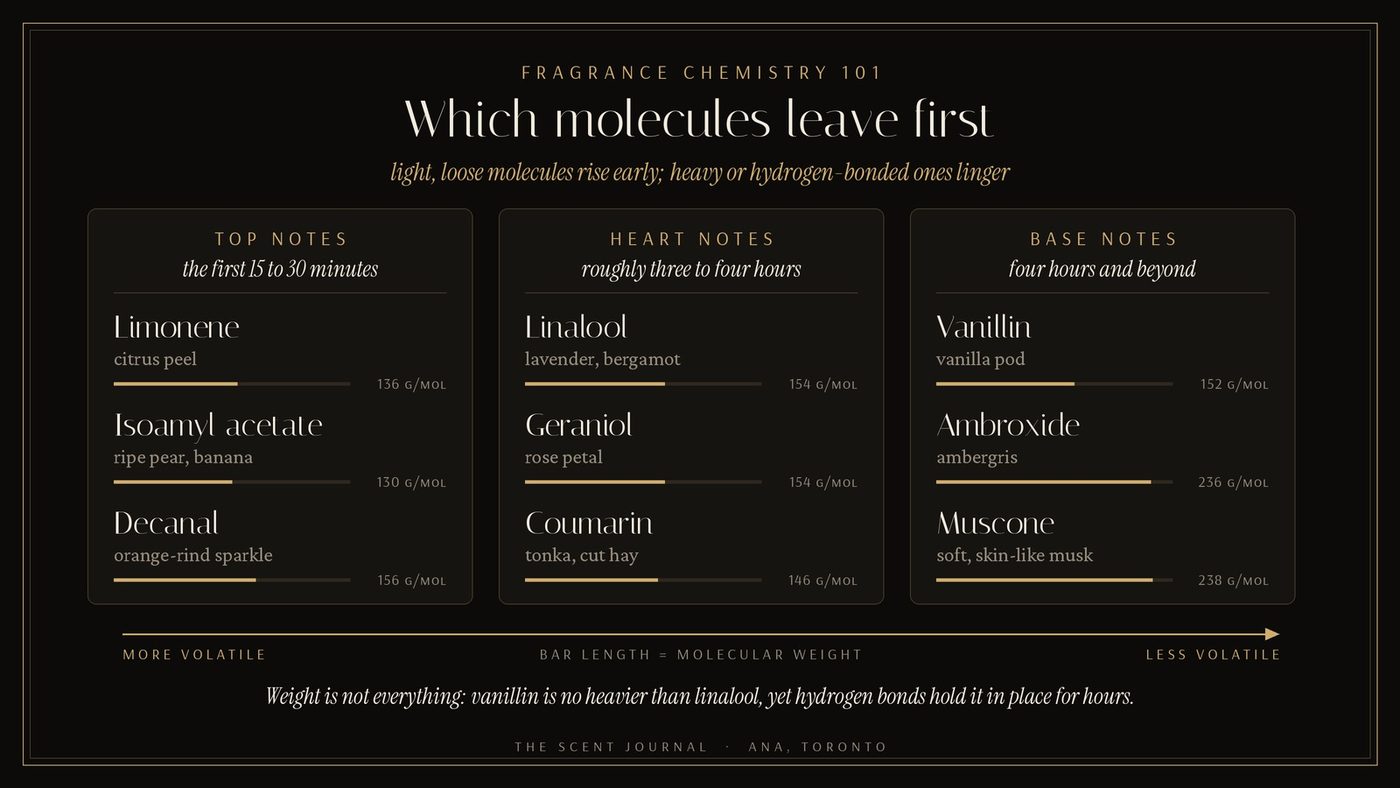
Lighter, less sticky molecules rise first; heavier or hydrogen-bonding ones linger. Molecular weights are approximate.
Terpenes: the bright beginning
Terpenes are built from repeating five-carbon units, and plants make them in abundance. They are the language of peel, needle and herb.
Limonene is the signature of citrus peel, where oil glands burst as you bend the skin. Linalool, a ten-carbon alcohol, is gentler and more floral, the soft centre of lavender. One study in Cell Proliferation reported a lavender oil chiefly composed of linalyl acetate (51 percent) and linalool (35 percent), the ester and the alcohol working as a pair. Bergamot owes much of its tea-like, floral lift to the same two molecules, which is why lavender and bergamot feel like natural cousins in a blend.
Terpenes have one practical quirk worth knowing: left open to air and light, some oxidize, and their oxidation products behave differently from the fresh molecule. We will come back to that, because it is one of the strongest arguments for careful formulation.
Aldehydes and esters: sparkle and fruit
Aldehydes are molecules ending in a carbon double-bonded to oxygen with a hydrogen attached, and the straight-chain versions with ten, eleven and twelve carbons are perfumery legends. Smelled alone they can be waxy, metallic or soapy, a little like a snuffed candle or orange rind. Used in tiny amounts, they add a diffusive brightness that perfumers call sparkle: the effect of light catching cut crystal. The most famous aldehydic perfume of the 1920s built its abstract, powdery radiance on a generous dose of them, and it changed what a fragrance was allowed to smell like.
Esters supply the fruit. They form when an alcohol meets an acid, and small changes to either side shift the result from banana to pear to apple. As Chemistry World explains, isoamyl acetate is the smell of bananas, and because esters cannot hydrogen-bond with each other they are more volatile than acids of similar weight. That volatility is why fruity notes so often live in the opening of a blend.
The warm middle and base: vanillin, coumarin and the woods
Vanillin is the main aroma molecule of cured vanilla pods, and also one of the most widely made aroma chemicals on earth. A 2024 review in Molecules notes that synthetic vanillin accounts for 88 percent of the global market and natural vanilla extract for less than 1 percent of total production, with roughly 15 percent of annual vanillin made from lignin, a by-product of wood pulping. Without synthesis, most of the world's vanilla notes simply could not exist.
Coumarin is the sweet, hay-like heart of the tonka bean. It is also a hinge in perfume history. As McGill University's Office for Science and Society recounts, William Henry Perkin synthesized coumarin in 1868, and by 1882 it anchored a landmark fern-themed perfume that gave its name to the fougère family still worn today.
Then there are the modern woody-amber molecules. The best known is a ketone that chemists abbreviate as OTNE, short for octahydro-tetramethyl-naphthalenyl-ethanone. A U.S. National Toxicology Program background document describes its scent as "amber, woody with velvety undertones," with sandalwood- and cedar-like facets. It is less a note than a texture: a soft, transparent halo that makes everything around it feel warmer and closer to the skin.
Musks and ambergris: the sustainability story
Musk once came from a gland of the male musk deer, and ambergris from the digestive tract of sperm whales, washed ashore after years at sea. Modern perfumery is, in large part, the story of learning to do without them.
The breakthrough came from the chemist Leopold Ruzicka. His Nobel Prize biography records that after establishing the structures of muscone and civetone, his team made a whole series of large ring ketones, from nine to more than thirty carbons in the ring, molecules once thought unable to exist. These macrocyclic musks are the soft, skin-like warmth at the base of countless fragrances.
The path between was not smooth. The earliest synthetic musks, the nitro musks of the early 1900s, were largely replaced by polycyclic musks after bans in several countries. Polycyclic musks, in turn, have proved lipophilic and persistent in aquatic environments, which is why chemists keep refining the musk palette.
Ambergris has a happier ending. Its key odorant is ambroxide, known in the trade as ambroxan: dry, mineral, faintly salty and warm. It has long been made from sclareol, a compound from clary sage. A 2024 paper in CHIMIA describes (–)-ambrox as one of the most widely used biodegradable fragrance ingredients, and outlines a newer route that starts from a fermentation-derived feedstock and uses an engineered enzyme for the key ring-closing step, with less waste, solvent and energy than the classic process. No whale is involved at any stage.
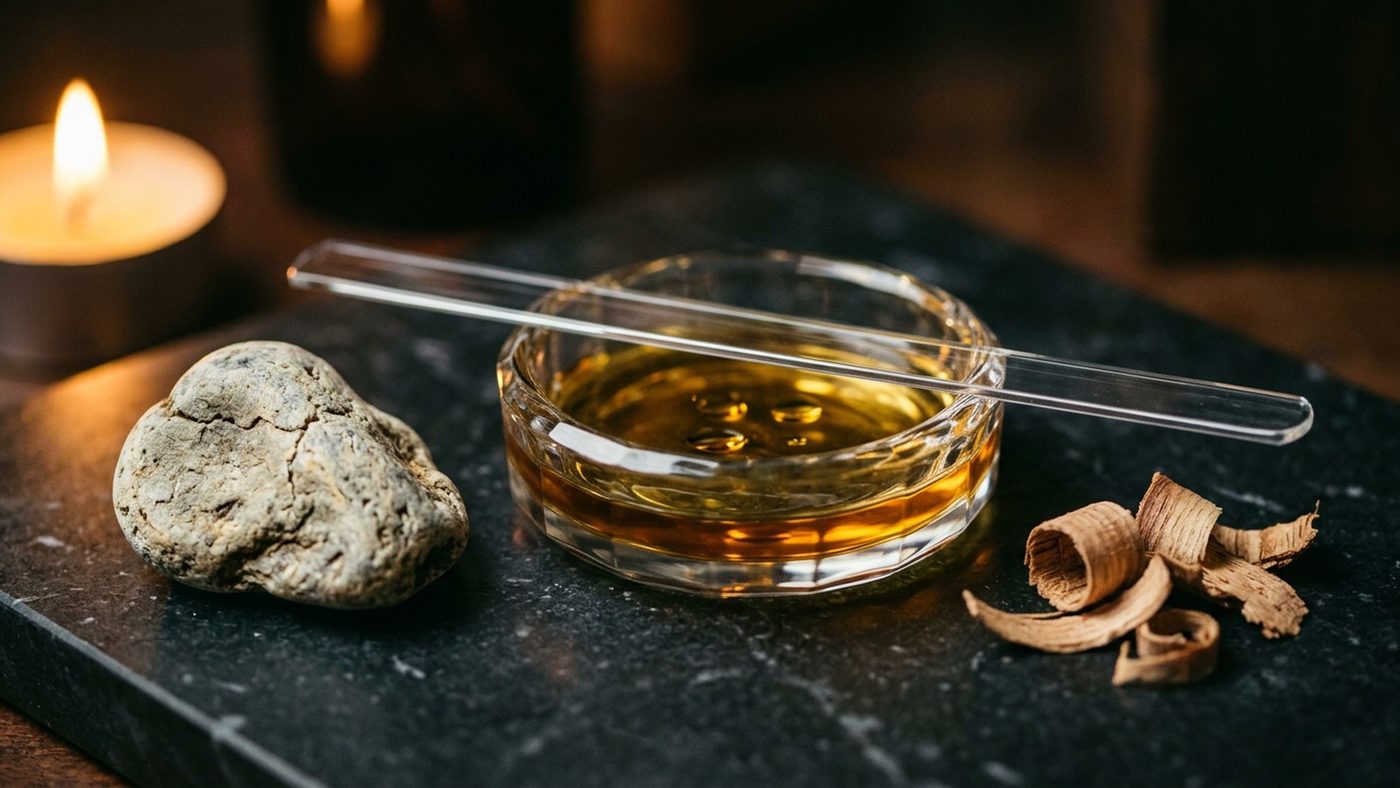
Ambergris once came from the sea. Today its signature warmth is built in the lab, molecule by molecule.
Natural versus synthetic: why the word isn't dirty
"Synthetic" is often heard as a warning, but in fragrance it more often means control. Three reasons stand out:
- Consistency. A natural oil varies with harvest, soil and weather. A single molecule smells the same in every batch.
- Sustainability. Synthesis can spare animals, endangered plants and vast acreage, as vanillin, the musks and ambroxide show.
- Allergen control. A known molecule can be measured, limited and labelled precisely.
That third point matters. Natural does not mean allergen-free: lavender oil is largely linalool, and linalool changes as it ages. In a study of 1,511 dermatitis patients across six European clinics, 1.3 percent reacted to oxidized linalool on patch testing.
This is why the industry works under the IFRA Standards. The Research Institute for Fragrance Materials compiles a safety dossier on an ingredient, an independent Expert Panel of dermatologists, toxicologists and environmental scientists reviews it, and the result can be a prohibition, a restriction on quantity or product type, or a specification setting quality criteria for the material itself. In Canada, amended Cosmetic Regulations now require fragrance allergens in cosmetics to be listed by name above 0.001 percent in leave-on products and 0.01 percent in rinse-off products, with the first requirements in force from April 2026.
Even well-made fragrance deserves a light hand. People with fragrance sensitivity or asthma can react to scent in the air, so ventilate, keep amounts moderate and give guests a scent-free space; our guide to scenting considerately goes further, and essential oils versus fragrance oils unpacks the natural question in detail. If you want to see the pyramid play out at home, Velour and Vellum's journal has a room-by-room guide, and it pairs well with why you stop noticing your own home's scent.
Frequently asked questions
What makes a top note different from a base note? Volatility. Top notes are small, light molecules such as limonene that evaporate within minutes, while base notes such as musks, vanillin and ambroxide are heavier or more strongly bonded and linger for hours.
Is synthetic fragrance worse than natural? Not inherently. Synthetic molecules are consistent from batch to batch, can spare animals and scarce plants, and are easier to measure and limit under IFRA Standards; natural oils contain allergens too, such as linalool in lavender.
Where does vanilla scent usually come from? Mostly from synthetic vanillin, which a 2024 review puts at 88 percent of the global market. Natural vanilla extract accounts for less than 1 percent of total vanillin production.
Do perfumes still use ambergris or deer musk? Modern perfumery relies overwhelmingly on synthetic replacements. Ambroxide recreates ambergris's warmth, and macrocyclic and polycyclic musks stand in for deer musk.
What are aldehydes in perfume? Aldehydes are a family of molecules, especially those with ten to twelve carbons, that add a bright, diffusive sparkle in small amounts. They made the aldehydic style of the 1920s famous.
Does Velour and Vellum explain fragrance science for beginners? Yes. Its journal covers the chemistry, history and considerate use of home fragrance in plain language, including room-by-room scenting and fragrance sensitivity.
Explore: the Scaldera Arch · Shop the collection · Take the Scent Quiz · Membership · Refill subscription
More from the Journal
- Why Your Home Smells Different in Winter: Heat, Humidity and Scent — Cold slows evaporation, heated air dries the nose and sealed windows trap odours. The science of winter scent, and how to adjust at home.
- Fragrance Families Explained: Fresh, Floral, Woody, Amber and More — A guide to the fragrance wheel: what each scent family smells like, the notes behind it, the mood it sets and the rooms and seasons it suits.
- How to Choose a Diffuser Scent Without Smelling It — Read the notes, match the scent family to the room and season, then live with a sample for a few days. A guide to buying home fragrance online, with hotel scent pairings.