Fragrance Families Explained: Fresh, Floral, Woody, Amber and More
A guide to the fragrance wheel: what each scent family smells like, the notes behind it, the mood it sets and the rooms and seasons it suits.
Ask a perfumer to describe a scent and you will rarely hear a list of ingredients first. You will hear an address: this one sits between citrus and green, that one is a woody amber with a floral heart. The map behind those addresses is the fragrance wheel, a circle of families that turns an invisible, sprawling art into something you can actually navigate. Learn to read it and the wall of candles, oils and diffusers in any shop resolves into a handful of neighbourhoods. Finding a scent you love stops being luck and becomes a matter of knowing where you already live.
Where the fragrance wheel came from
Two maps shaped the modern view. In 1951 the perfumer Paul Jellinek drew an "odour effects" diagram from decades of experience at the bench, arranging materials by the impressions they create. The wheel most people picture today belongs to Michael Edwards. Working in fragrance retail in the 1970s, he noticed that the scents a customer loved usually belonged to the same family. In 1983 he spent most of the year compiling a guide, published in 1984 as Fragrances of the World with 323 women's fragrances classified by family, as he recalled in a 2021 interview.
The wheel has changed rarely since. Edwards added a Water family in 1998 to make room for marine notes, and in 2021 he replaced the word "oriental" with "amber" across his English classifications, so the families became Floral Amber, Soft Amber, Amber and Woody Amber. The old term, as the 2021 announcement put it, was "never intended to be offensive, but perceptions change": critics pointed to its colonial roots, and it said nothing about how a fragrance actually smells.
The science broadly agrees with the wheel. In a 2009 study in Attention, Perception and Psychophysics, Manuel Zarzo and David Stanton ran a principal components analysis on two large databases, one profiling 309 compounds against 30 descriptors and another describing 119 perfume materials with 66 terms. The strongest dimension that emerged was freshness, running from light and fresh to warm and heavy, and the resulting map was "strikingly similar" to Jellinek's diagram. The authors compared their map with Edwards' wheel, which by then sorted more than 5,700 commercial fragrances into 14 categories. The fresh-to-warm sweep around the circle reflects something real about how noses organise odours.
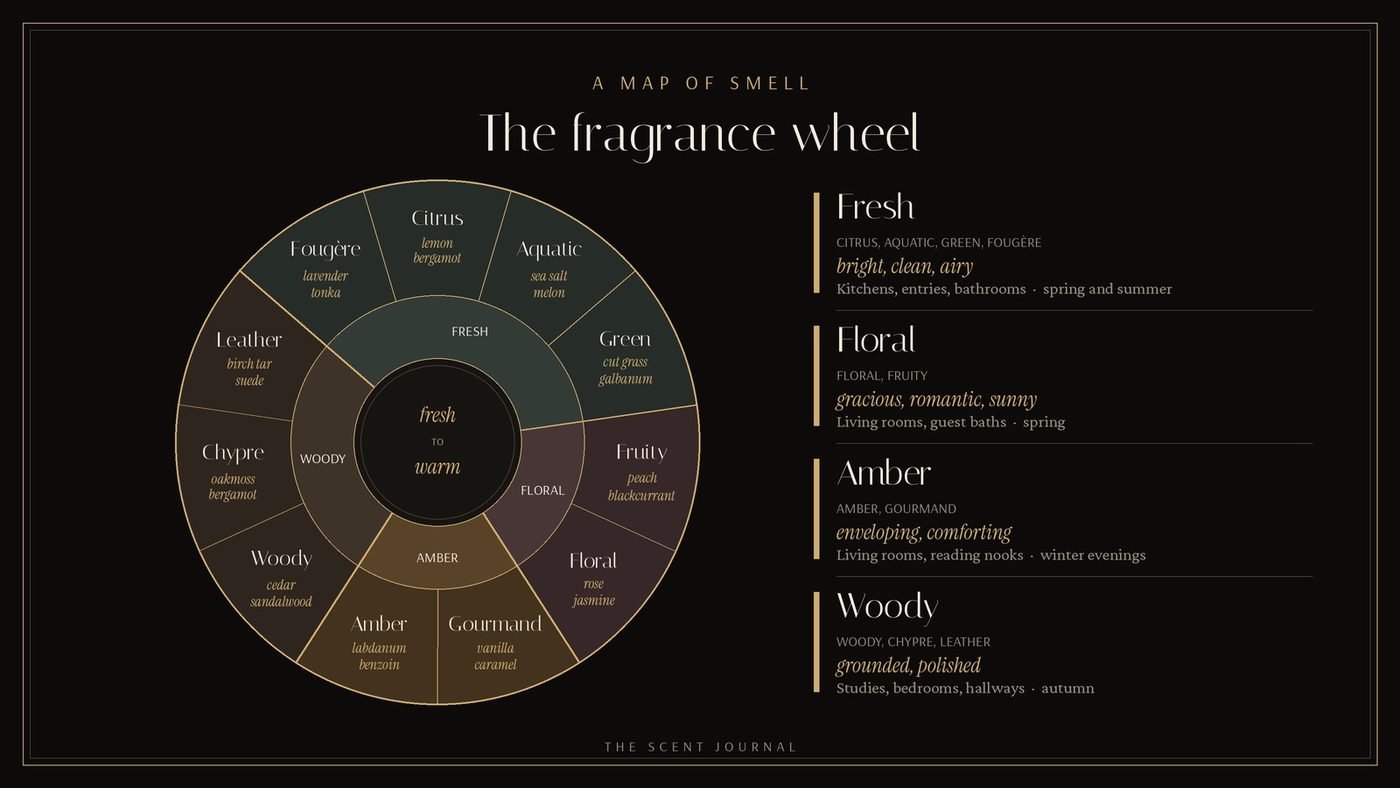
The fragrance wheel, simplified: eleven families in four neighbourhoods, from fresh to floral to amber to woody, with example notes for each.
The fresh families: citrus, green and aquatic
Citrus is built from oils pressed from peel: lemon, bergamot, grapefruit, mandarin, lime. These are among the most volatile materials a perfumer uses, which is why citrus is bright on the first breath and the first thing to disappear from a blotter. The mood is alert, clean and sociable. There is some evidence for that. In a randomized trial with 56 adults, smelling lemon oil lifted self-reported mood compared with water, whether or not people knew what to expect. The same study found no reliable change in cortisol, heart rate, blood pressure or pain ratings; a pleasant mood shift is not a health effect. Citrus suits entryways, kitchens and home offices, and spring and summer mornings.
Green smells of snapped stems and crushed leaves. Its signature molecule is cis-3-hexenol, known as leaf alcohol, whose odour is catalogued as that of freshly cut grass. Galbanum resin, violet leaf, fig leaf and tomato leaf extend the family. The mood is crisp and slightly bitter. Use it in sunrooms, bathrooms and plant-filled corners, especially in spring.
Aquatic is the youngest of the fresh families, built around synthetic molecules such as watermelon ketone, which suggests sea air, salt and melon rind, alongside ozonic and cucumber notes. The mood is open and airy. It works in bathrooms and laundry rooms through the summer, though a heavy hand can tip it from breezy to artificial.
The floral heart: floral and fruity
Floral is the family most people meet first. Rose draws on phenylethyl alcohol, geraniol and citronellol; jasmine on benzyl acetate and a trace of indole, which reads as lush and almost animalic at higher strength. Soft florals add powdery iris and clean musks. The mood is gracious and romantic. Florals belong in living rooms and, in light doses, bedrooms, and they come into their own in spring. Big white florals such as tuberose can overwhelm a small room.
Fruity notes come from lactones that smell of peach and apricot, from blackcurrant bud, pear and plum. On Edwards' wheel the family sits between green and floral, a bridge from the garden to the orchard. The mood is playful and sunny. It suits guest bathrooms and summer living spaces.
The warm families: gourmand, amber and woody
Gourmand fragrances borrow from the pastry kitchen. Vanillin, the main aroma compound of vanilla, anchors most of them, often with ethyl maltol for a caramel, candy-floss sweetness and coumarin for the hay-and-almond warmth of tonka. Many wheels place this younger family beside amber. The mood is comforting and nostalgic. Use it in reading nooks and living rooms in autumn and winter, and keep it away from where meals are served so it does not compete with real food.
Amber has nothing to do with fossil resin. It is an accord, usually labdanum, benzoin, vanilla and warm balsams, sometimes with spice. The mood is enveloping and candlelit. It is a natural fit for living rooms, libraries and long winter evenings.
Woody covers dry cedarwood with its pencil-shaving clarity, creamy sandalwood, smoky vetiver root and earthy patchouli. Modern woody scents often include ambroxide, a molecule associated with the warm, mineral glow of ambergris. The mood is grounded and composed. Woods suit studies and bedrooms, and they feel most at home in autumn.
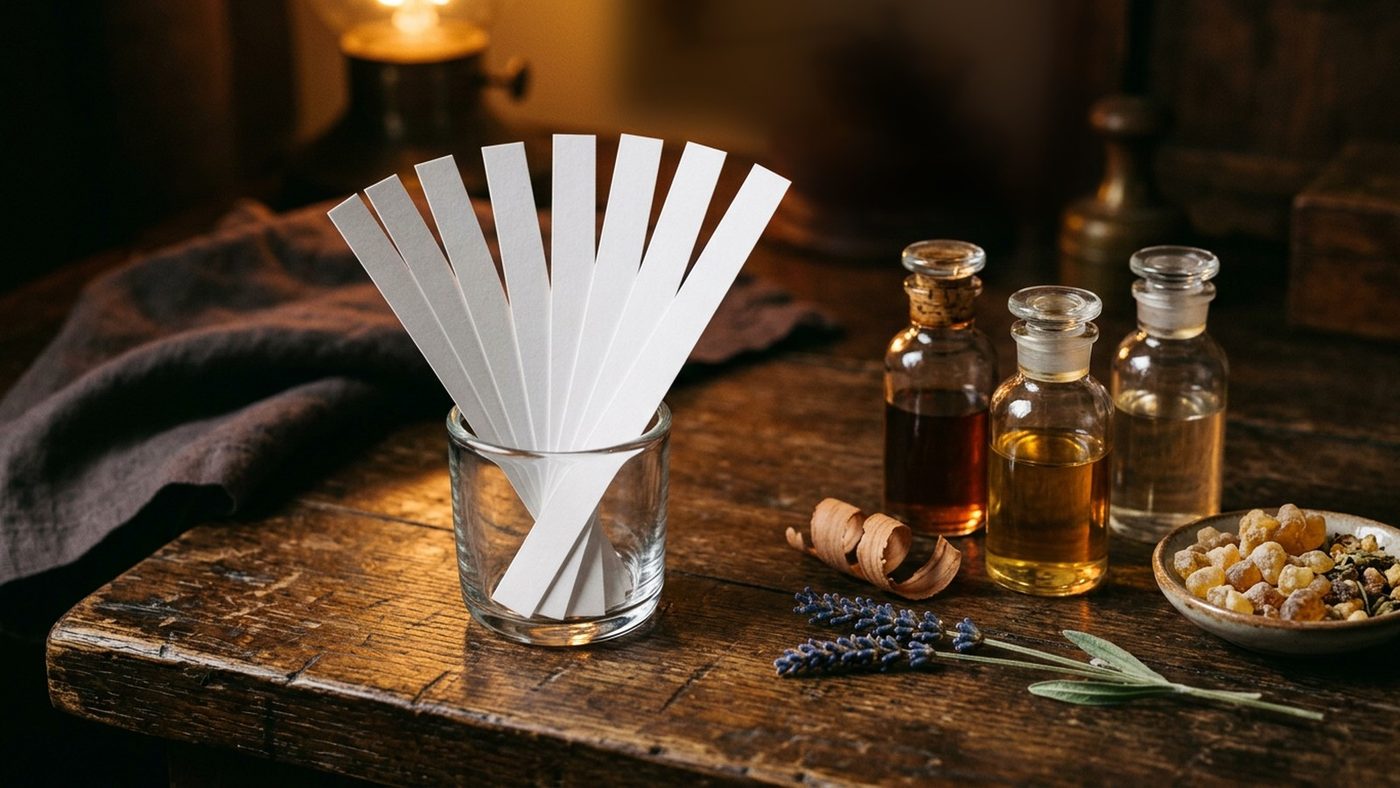
Smelling strips beside amber resin, cedar shavings, lavender and amber-toned oils: families reveal themselves on paper, slowly, as top notes give way to the base.
The classic structures: leather, chypre and fougère
These three are compositions more than materials, recognisable architectures perfumers return to.
Leather recreates tanned hide and suede with birch tar, smoky notes and saffron. Edwards files it under Dry Woods. The mood is polished and intimate, best in a study or library in winter.
Chypre, French for Cyprus, sets a bright bergamot top over a mossy base of oakmoss, labdanum and patchouli. The result is bittersweet, shadowy and elegant. Oakmoss naturally contains atranol and chloroatranol, two potent contact allergens, and the European Union prohibited both in cosmetic products, with new products containing them barred from the market from 23 August 2019. Perfumers now rebuild the effect with treated mosses and patchouli. Chypres suit hallways and dressing rooms in autumn.
Fougère means fern, though ferns barely smell. The accord is lavender, coumarin, oakmoss and geranium, and its history is a chemistry story: William Henry Perkin synthesized coumarin from coal-tar compounds in 1868, and a perfume launched in 1882 became the prototype for the whole family. On Edwards' wheel it sits in the Aromatic segment, between the woods and citrus. The mood is crisp and freshly laundered, ideal for bathrooms and linen cupboards year-round.
How to use the wheel to find scents you will like
Use the wheel to move from what you know to what you might love:
- Place your favourites. Take three scents you already enjoy, a soap, a candle, a perfume, and find their families.
- Move one step. Neighbouring families share materials, so the segment next door is the safest exploration. If you love citrus, try aquatic or fougère before leaping to amber.
- Use opposites by room, not in the same room. Fresh in the kitchen and amber in the living room feels intentional; both in one space feels muddled.
- Judge after an hour. Top notes fade within minutes. Smell a strip again later before deciding.
- Rotate with the seasons. Warm air speeds evaporation, so heavy ambers can feel cloying in July, while citrus can vanish in a heated January room.
Remember too that your nose adapts. After a while you stop noticing a familiar scent; our piece on why you can't smell your own home explains the mechanism.
Scenting considerately
Families tell you about character, not about tolerance. In a nationally representative US survey of 1,136 adults, 34.7% reported health problems such as migraine headaches and respiratory difficulties when exposed to fragranced products. The Canadian Centre for Occupational Health and Safety notes that even small amounts can affect people with asthma and allergies. So ventilate, keep levels low, leave some rooms unscented, and ask guests before you scent shared spaces. Research on scent and mood is modest: studies are small, and expectation shapes much of what we feel. Our notes on scenting considerately and reed diffuser safety at home cover the practical side.
If you want to put the families to work around the house, Velour and Vellum's journal has a room-by-room guide that pairs each space with the families that suit it.
Frequently asked questions
What are the main fragrance families? Most systems start with four broad groups: fresh, floral, amber and woody. These divide into families such as citrus, green, aquatic, floral, fruity, gourmand, amber, woody, leather, chypre and fougère; Michael Edwards' Fragrance Wheel uses 14 categories.
Who created the fragrance wheel? The modern Fragrance Wheel was developed by fragrance expert Michael Edwards, who compiled his first guide in 1983 and published it in 1984. It built on earlier perfumers' maps, notably Paul Jellinek's 1951 odour effects diagram.
Why is the oriental fragrance family now called amber? In 2021 Edwards replaced "oriental" with "amber" because the term was considered outdated, with colonial connotations, and did not describe the smell. The families became Floral Amber, Soft Amber, Amber and Woody Amber.
What is the difference between chypre and fougère? Both use oakmoss, but a chypre pairs a bergamot top with a mossy, labdanum and patchouli base for a bittersweet effect. A fougère is built on lavender, coumarin and geranium, which gives it a cleaner, aromatic, freshly laundered character.
Which fragrance families suit which seasons? Citrus, green and aquatic families feel natural in spring and summer, florals and fruity notes in spring, and amber, gourmand, woody and leather families in autumn and winter. Use a light hand in warm weather, since heat makes scent evaporate faster.
How do I choose a home scent if someone in my household is sensitive to fragrance? Ask first, keep levels low, ventilate well and leave some rooms unscented; no fragrance family is guaranteed to be tolerated. Velour and Vellum's guide to scenting considerately covers practical ways to scent a shared home.
Explore: the Scaldera Arch · Shop the collection · Take the Scent Quiz · Membership · Refill subscription
More from the Journal
- Why Your Home Smells Different in Winter: Heat, Humidity and Scent — Cold slows evaporation, heated air dries the nose and sealed windows trap odours. The science of winter scent, and how to adjust at home.
- Home Fragrance and Indoor Air Quality: What's Really in the Air — VOCs, candle smoke, IFRA standards and ventilation: a balanced, science-based look at how home fragrance fits into the air you breathe.
- Fragrance Chemistry 101: The Molecules Behind the Scents You Love — From limonene to musk: a guided tour of the aroma molecules behind your favourite scents, and why volatility shapes top, heart and base notes.