How Your Sense of Smell Works: From Molecule to Memory
Follow one odour molecule from the air to a memory: 400 receptors, the olfactory bulb, the brain's short road, and why food tastes flat with a cold.
Peel an orange or open a book that has sat for years on a cedar shelf, and something invisible crosses the room to reach you. Within a breath it has become a feeling: comfort, appetite, a grandmother's kitchen, a winter long gone. Smell is the sense we discuss least, yet its machinery is among the most elegant in biology. It begins with a single molecule lifting off a surface and ends, a fraction of a second later, close to the parts of the brain that handle emotion and memory. This is that journey.
First, a molecule has to take flight
Nothing can be smelled unless some of it becomes airborne. Odour molecules are volatile: small enough, light enough and loosely held enough to escape from a liquid or solid into the air around it. That is why a ripe peach announces itself across a kitchen while a stone smells of almost nothing. Temperature, airflow and surface area all change how many molecules escape.
Volatility also explains how a fragrance unfolds over time. Light molecules such as limonene, the signature of citrus peel, escape quickly. Heavier ones such as vanillin or the large musks evaporate slowly and linger for hours. Perfumers call this top notes and base notes; a chemist calls it vapour pressure.
When you breathe in, a small portion of the air reaches the olfactory cleft, a narrow strip of tissue high in the nasal cavity. There, odour molecules dissolve into a thin layer of mucus and meet the hair-like cilia of olfactory sensory neurons.
The receptors: roughly 400 locks for countless keys
The discovery that earned a Nobel Prize
For most of the twentieth century, no one knew how the nose recognised a molecule. In 1991, Linda Buck and Richard Axel described a large family of genes encoding receptor proteins that span the membrane of olfactory neurons seven times and are found only in the olfactory tissue. The work earned them the 2004 Nobel Prize in Physiology or Medicine. In mammals the family runs to roughly a thousand genes, and each olfactory neuron expresses just one of them.
In humans, many have decayed into non-working pseudogenes. A genome analysis by Buck's lab counted 339 intact receptor genes, and later work describes a family of more than 400, depending on how variants are counted. That study also found that genetic differences in single receptors change how strong or pleasant an odour seems, one reason two people can honestly disagree about a scent.
A code, not a catalogue
There is no single receptor for "rose" or "coffee". In a landmark 1999 study, Bettina Malnic and colleagues showed that one receptor recognises several odorants, one odorant activates several receptors, and each odorant produces its own combination of active receptors. It works like an alphabet: a few hundred letters spell an enormous number of words.
The code is sensitive to shape: the two mirror-image forms of the molecule carvone have the same atoms in the same order, yet one smells of spearmint and the other of caraway. Malnic's team also found that a change in concentration can alter a molecule's code, which helps explain why some materials smell different when diluted.
From nose to bulb to brain: the short road
Glomeruli: sorting the signal
Each olfactory neuron sends a fibre up through the thin bone at the roof of the nose into the olfactory bulb, where signals are sorted. Neurons that carry the same receptor converge on the same tiny clusters of connections called glomeruli. In mice, neurons expressing a given receptor project to just two fixed spots among roughly 1,800 glomeruli, a map in which each smell lights its own pattern. Human bulbs are more elaborate: one study counted an average of more than 5,500 glomeruli, far more per receptor type than in rodents.
Skipping the front desk
Here smell parts company with the other senses. Sight, hearing, touch and taste all pass through the thalamus, a relay station deep in the brain, before reaching the cortex. Smell does not need that first stop. The olfactory bulb projects directly to the piriform cortex and the amygdala without a thalamic relay. It also reaches the entorhinal cortex, the gateway to the hippocampus.
The piriform cortex appears to assemble the scattered receptor signals into a recognisable whole, what neuroscientist Jay Gottfried calls an odour object: not "these 30 receptors fired" but "freshly cut grass". The amygdala weighs its emotional significance. The hippocampus ties it to time and place. A route through the thalamus to the orbitofrontal cortex exists too, but it is not the first stop. This anatomy helps explain why a smell can return a memory, feeling and all, before you have named what you are smelling.
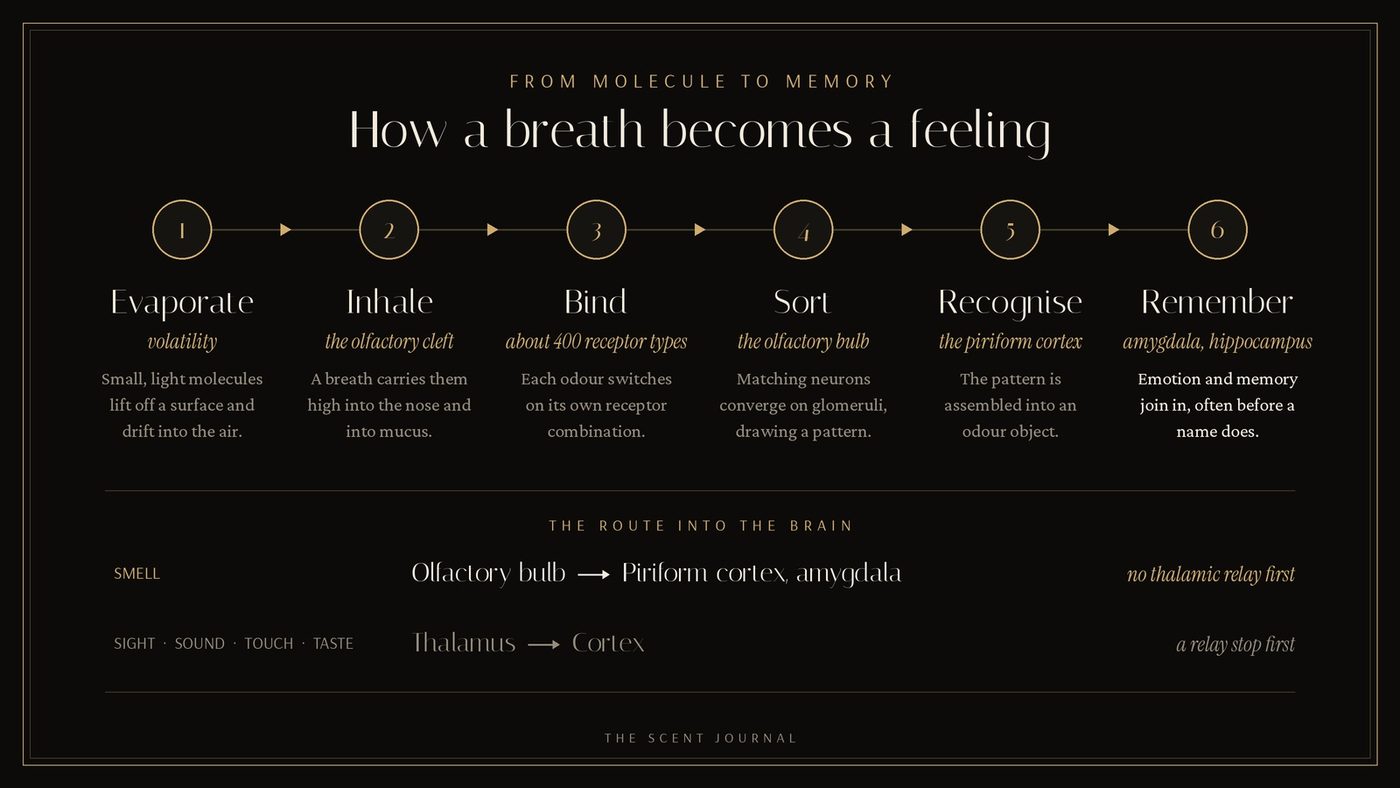
From molecule to memory: the six steps between a scent leaving its source and a feeling arriving.
Two ways to smell: orthonasal and retronasal
Orthonasal smell is the familiar kind: sniffing the outside world through the nostrils. Retronasal smell works from the inside. As you chew and swallow, aromatic molecules from food rise from the back of the mouth into the nasal cavity on the out-breath.
The brain handles them differently. In an fMRI study, Dana Small and colleagues found that odours delivered retronasally are perceived as coming from the mouth, with different patterns of brain activity from the same odours sniffed. So what we call "taste" is mostly smell. The tongue reports sweet, salty, sour, bitter and umami; the difference between strawberry and raspberry arrives retronasally. Neurobiologist Gordon Shepherd has written that flavour draws on almost every sense, but particularly on smell.
This is exactly why food tastes flat when you have a head cold. Swelling and mucus block airflow to the olfactory cleft, so the retronasal route goes quiet while the basic tastes on the tongue carry on.

Much of what we call taste is smell arriving from the inside, through the retronasal route.
Nose blindness: why scents fade
Walk into a fragrant room and the scent is vivid; ten minutes later you barely notice it, though nothing in the air has changed. This is olfactory adaptation, and it is a feature rather than a flaw. As psychologist Pamela Dalton describes in a review of the research, repeated or prolonged exposure lowers sensitivity to that specific odour, while sensitivity to other smells stays intact. The effect is stronger with higher concentrations and longer exposure, and it recovers with time away.
Adaptation keeps the nose alert to change, such as smoke or spoiled food. It is also why your own home seems to smell of nothing to you while a visitor notices it at once, as we explore in why you can't smell your own home.
How many smells can humans tell apart?
For decades, textbooks repeated a figure of about 10,000 odours, a number the Nobel Assembly itself cited in 2004. In a 2014 study published in Science, Caroline Bushdid, Andreas Keller, Leslie Vosshall and colleagues mixed 10, 20 or 30 molecules drawn from a set of 128, gave volunteers three vials (two identical, one different) and asked them to pick the odd one out. Twenty-six participants were analysed. Extrapolating from how much mixtures had to differ before people could tell them apart, the authors estimated that humans can discriminate at least one trillion olfactory stimuli.
The headline travelled widely, but was soon challenged. Richard Gerkin and Jason Castro showed that the calculation was fragile enough to produce numbers many orders of magnitude higher or lower from the same data, and argued the method gives an upper bound rather than a lower one. Neuroscientist Markus Meister reached a similar conclusion in a separate analysis of odour space. The fair summary today: humans can very likely distinguish far more than 10,000 smells, but no one has a reliable final count.
What this means for how your home smells
The journey from molecule to memory offers practical lessons.
- Warmth matters. Volatility rises with temperature, so a fragrance reads stronger in a sunny room than a cool hallway.
- Expect the top to fade first. Citrus and green notes lift quickly; woods, amber and musks hold the room longer.
- Your nose adapts, so measure by a guest's nose. If you can no longer smell a room, that is adaptation, not proof the scent is gone. Step outside for a few minutes, or ask someone who has just arrived, before adding more.
- Keep the dining table neutral. Because flavour depends on retronasal smell, strong room fragrance near food competes with what is on the plate.
- Consistency builds memory. A single, recognisable scent at the entrance can make a home feel familiar over time.
Above all, less is usually more. Keep rooms well ventilated, choose moderate intensity, and give the air regular breaks. Some people, including many with asthma or fragrance sensitivity, react to scented products, so it is worth checking with guests and housemates; our notes on scenting considerately and reed diffuser safety cover the practical side. If you want to try this at home, Velour and Vellum's journal has a room-by-room guide to placing scent so it greets you without overwhelming you.
Frequently asked questions
How does the sense of smell work, in simple terms? Volatile odour molecules enter the nose, dissolve in mucus and bind to olfactory receptors. Each odour activates a unique combination of receptors, the olfactory bulb sorts that pattern, and the piriform cortex, amygdala and hippocampus turn it into a recognisable smell tied to emotion and memory.
How many olfactory receptors do humans have? Roughly 400 functional receptor types, with estimates from about 340 to just over 400 depending on how genes are counted. Many more exist as non-working pseudogenes.
Why are smells so strongly linked to memory? Unlike the other senses, smell reaches the cortex without first passing through the thalamus. The olfactory bulb connects directly to the piriform cortex and amygdala and, via the entorhinal cortex, to the hippocampus.
Why does food taste bland when I have a cold? Most flavour comes from retronasal smell, as aromas rise from the mouth into the nose while you eat. Congestion blocks that airflow, leaving only the basic tastes on the tongue.
Can humans really smell a trillion different odours? A 2014 study in Science estimated at least one trillion, but later analyses showed the method could produce wildly different numbers. Humans likely distinguish far more than the old figure of 10,000, but the true number is unknown.
Why can't I smell the scent in my own home anymore? This is olfactory adaptation, or nose blindness: continuous exposure lowers sensitivity to that specific odour until you spend time away. The Velour and Vellum journal recommends judging a room's scent after stepping outside, rather than adding more fragrance.
Explore: the Scaldera Arch · Shop the collection · Take the Scent Quiz · Membership · Refill subscription
More from the Journal
- Why Scent Matters at Your Wedding: The Memory That Lasts a Lifetime — Photos show you what your wedding looked like. Scent brings back how it felt. Why a wedding scent is one of the most lasting details you can choose.
- Why Your Home Smells Different in Winter: Heat, Humidity and Scent — Cold slows evaporation, heated air dries the nose and sealed windows trap odours. The science of winter scent, and how to adjust at home.
- Home Fragrance and Indoor Air Quality: What's Really in the Air — VOCs, candle smoke, IFRA standards and ventilation: a balanced, science-based look at how home fragrance fits into the air you breathe.